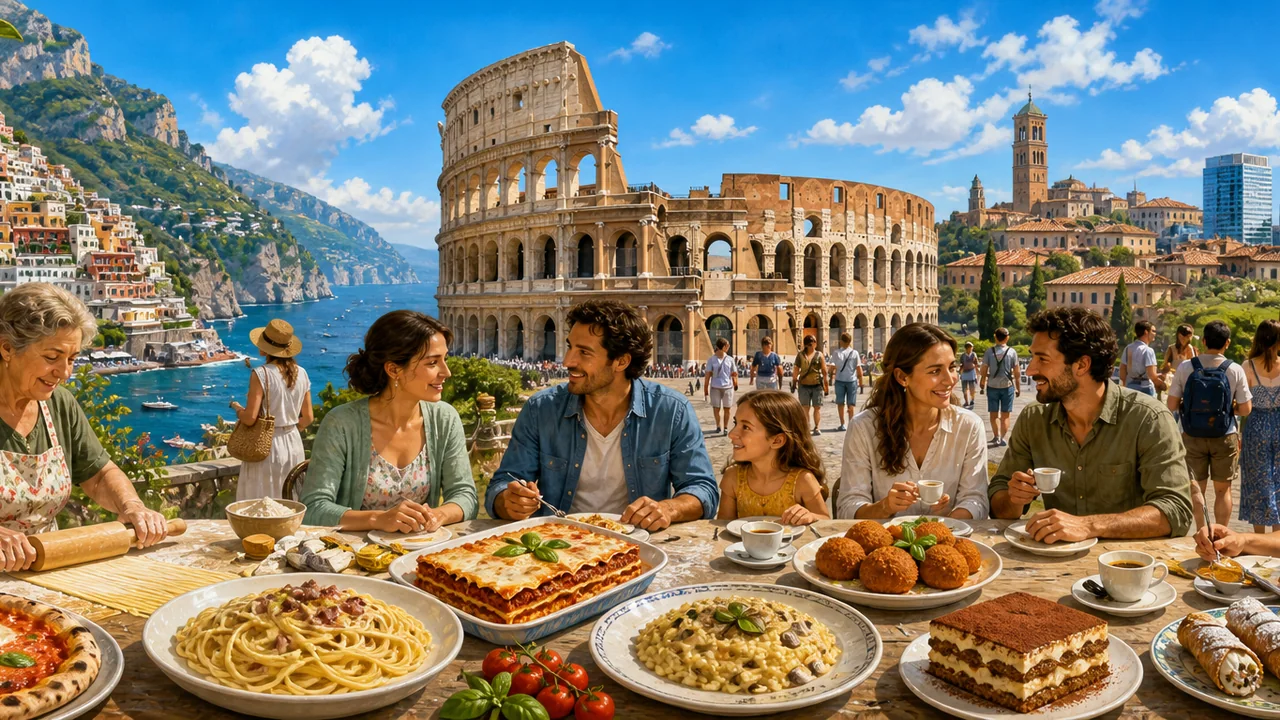
Eating in Italy: what to order, when to eat it and how
- Capital Rome
- Official language Italian
- Currency Euro
- Best time to visit Spring, autumn
Italian food has deep roots. The first known Italian food writer, Archestratus of Syracuse in the 4th century BC, called for top-quality, seasonal ingredients and simple preparation. A culture of gastronomy followed in the Roman Empire, and by the 1st century AD the cookbook De re coquinaria held 470 recipes. From the 18th century, Italian cookbooks began to stress the cooking of each region, and they were no longer written only for professional chefs.
Simplicity is still the heart of it: many dishes have only a few ingredients, and many popular dishes were first made by ordinary people, which is why so many are easy to cook at home. The best-known Italian food in the world is pizza, and Neapolitan pizza is on UNESCO's list of intangible cultural heritage. Pasta, risotto, tiramisu and gelato are famous too, and every region has its own specialities: Bologna is known for its tortellini and Naples for its pizza. Dishes that began in one region have spread across the country, so the same name can taste a little different from one town to the next.
This guide follows the day at the Italian table, from breakfast to the sweets, and ends with the dishes that belong to holidays. Under each part you will find a few dishes from our catalogue that you can cook yourself.
Breakfast
Do not expect a big breakfast. Breakfast, called colazione, gets much less attention in Italy than in many countries. It is often light, and plenty of people skip it or keep it very small.
A pastry is the usual choice. The cornetto is the Italian name for a croissant-style pastry, made from dough, eggs, butter, water and sugar. If you want a cappuccino, have it in the morning. It is generally considered a morning drink and is usually not taken after a meal.
Dishes from our catalogue
- Cornetto · 670 kcal
Lunch and dinner
The day has three main meals: breakfast (colazione), lunch (pranzo) and dinner (cena). Lunch and dinner are the ones that matter, especially on weekends, when a meal is time with family and friends and not only food, so it tends to run long. Italians rank third among the OECD countries for time spent eating and drinking, about 114 minutes a day.
An everyday meal usually has a first course or a second course, sometimes both, plus a side dish and coffee. The first course (primo) is usually something filling such as pasta or risotto. Meat, such as sausages, meatballs or poultry, comes in the second course (secondo). A full multi-course meal is mostly kept for special occasions such as weddings.
Bread comes to the table for both courses. At the end of the meal it is used to wipe up the sauce left on your plate, which Italians call fare la scarpetta.
Dishes from our catalogue
- Authentic Spaghetti Carbonara · 650 kcal
- Risotto ai Funghi Porcini · 420 kcal
- Classic Lasagna alla Bolognese · 790 kcal
- Saltimbocca alla Romana · 270 kcal
- Pollo alla Cacciatora · 380 kcal
Snacks and street food
Between meals, Italians have a light snack called merenda, in the late morning or in the middle of the afternoon. Pizza is the easiest food to eat on the go. It is eaten as a snack, even while walking, as pizza al taglio. In casual places it is cut into slices and eaten by hand, while in a restaurant it comes unsliced and is eaten with a knife and fork.
Look also for flatbreads related to pizza, such as piadina, and for the deep-fried rice croquettes called arancini, a Sicilian speciality.
Dishes from our catalogue
- Classic Pizza Margherita · 725 kcal
- Pizza fritta
- Piadina romagnola · 650 kcal
- Sicilian Arancini · 940 kcal
- Supplì al telefono
Drinks
Espresso is the classic Italian coffee. It is served in a small cup, about 25 to 30 millilitres. A caffè macchiato is an espresso with a little steamed milk or foam on top.
With a meal, water and wine are the usual drinks, and it is very uncommon to have any other drink at the table. Beer is the traditional match for pizza.
Italians also have an aperitif before a meal, such as Campari, Martini or vermouth, and a digestif after it. After a heavy meal you may be offered an amaro. In Campania, around Naples, limoncello, a lemon liqueur, is served chilled in small glasses.
Sweets
Gelato is the Italian word for all ice cream, and Italy is famous for the artisanal kind. Tiramisu is among the most famous Italian desserts. In Sicily, look for cannoli, and in Piedmont for panna cotta.
Italians put biscuits and candy in the same category as sweets. Sugared almonds called confetti are given at weddings, baptisms and graduations.
Dishes from our catalogue
- Traditional Tiramisu · 550 kcal
- Cannoli siciliani · 220 kcal
- Panna cotta
- Sfogliatella Riccia · 180 kcal
Holidays and festivals
Every region has its own holiday dishes. On Easter Sunday, lamb is served throughout Italy, and the common Easter cake is the colomba pasquale, shaped like a dove.
On Christmas Eve, Italians keep a symbolic fast with a meatless dinner, the cena di magro. It is a rich family meal based on fish and seafood. The typical Christmas cakes are panettone and pandoro. In Sicily, on 19 March, Saint Joseph's Day, altars include fava beans, and people eat zeppole.
Dishes from our catalogue
- Panettone · 160 kcal
- Fritto misto di mare · 305 kcal
- Baccalà alla Vicentina · 585 kcal
Typical temperatures by month · Rome
| Jan | Feb | Mar | Apr | May | Jun | Jul | Aug | Sep | Oct | Nov | Dec | |
|---|---|---|---|---|---|---|---|---|---|---|---|---|
| Daytime high °C | 12.6° | 13.8° | 16.8° | 20° | 24.8° | 29.5° | 32.6° | 32.7° | 27.9° | 22.8° | 17.1° | 13.2° |
| Night low °C | 3.2° | 3.4° | 5.6° | 8.3° | 12.5° | 16.7° | 19.3° | 19.5° | 15.9° | 12.1° | 7.7° | 4.2° |
Restaurant listings are coming
We will list restaurants here once each one is checked. We never list a place we have not verified.
The facts on this page come from the sources below and from the tags of the dishes in the ChefSnap catalogue. A person reviews each guide before it goes live.